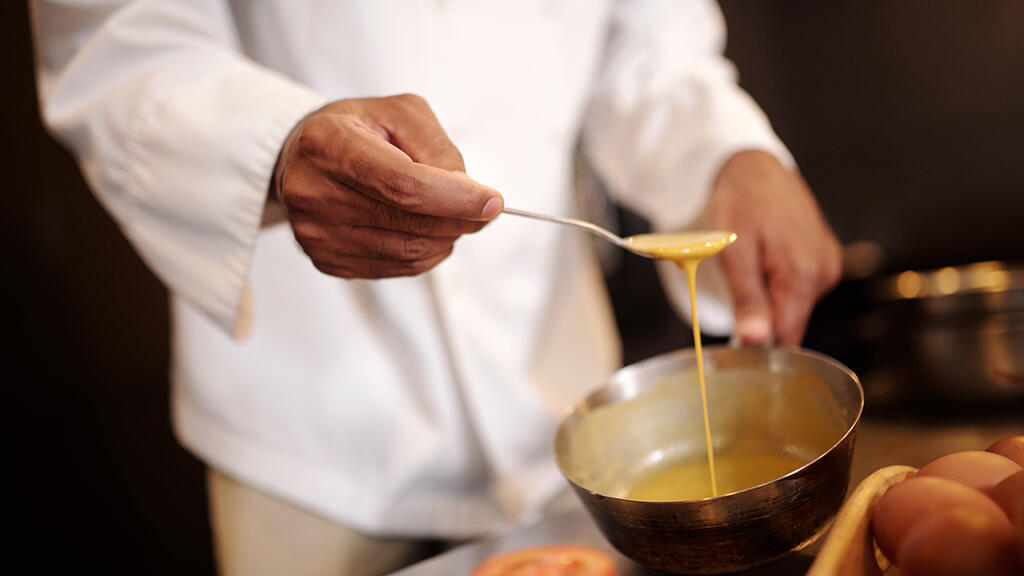
The primary reason for the differences seen in mayonnaise, vinaigrette, and hollandaise is due to the presence of an emulsifier. An emulsifier allows two liquids that cannot normally mix (oil and water) to remain stable together. Most cooking applications utilize either lecithin (present in egg yolks), mustard, or the proteins found in dairy products as an emulsifier.
These two categories differ primarily in terms of their duration. Some emulsions (temporary) exist only while physical force continues to act upon them (i.e., while being shaken/whipped/blended) and will eventually collapse. Examples include vinaigrettes made using only oil and vinegar, which come together during vigorous shaking but separate after the mechanical energy subsides. While temporary emulsions are useful for short-term purposes (re-shake/re-whisk as needed), they lack the structural integrity necessary to withstand prolonged storage.
On the opposite end of this spectrum are stable emulsions. A stable emulsion relies on an emulsifier to maintain the structure by physically separating oil and water droplets. A mayonnaise and a hollandaise are examples of stable emulsions. Both of these emulsions can remain stable for weeks/months, depending on the quality of the emulsifier and the degree to which the oil is dispersed through-out the mixture.
Building a Better Vinaigrette
At its simplest level, a classic vinaigrette consists of 3 parts oil to 1 part acid (typically vinegar or citrus). A basic vinaigrette is essentially a temporary emulsion -- shake it thoroughly immediately prior to serving and it will begin to break down within several minutes. However, by adding a single component to the basic vinaigrette recipe, you can improve both its stability and flavor complexity.
Dijon mustard is used as the sole additive. Unlike traditional mustard, Dijon mustard is known to contain mucilage -- a plant-derived emulsifier that serves as a link between oil and vinegar, enabling a vinaigrette to hold for hours instead of minutes. Honey also adds additional value as a secondary emulsifier, as well as a balance agent to reduce the acidity of the vinegar without imparting sweetness.
As with many components in cooking, proper preparation/techniques are crucial to achieving success. The oil should be added slowly and consistently (drop by drop at first and then gradually increased to a slow trickle) while constantly whisking. Adding oil too rapidly creates an imbalance in the system causing it to fail shortly thereafter. When creating a vinaigrette in a container (such as a jar), place all ingredients except the oil in the container. Drizzle the oil into the container while simultaneously shaking it violently and constantly.
Classical Vinaigrette Recipe
- Extra Virgin Olive Oil (EVOO): 3 parts
- Red or White Wine Vinegar: 1 part
- Dijon Mustard: 0.5 tsp.
- Black Pepper: To Taste
- Optional: Honey to Taste
Mayonnaise - The Ultimate Example of a Stable Emulsion
Mayonnaise is possibly one of the most impressive creations in all of cooking. With approximately 70-80% oil content, mayonnaise is a relatively oily substance that is still extremely thick and creamy -- and remarkably stable. The key factor responsible for this stability is lecithin contained within egg yolks. Egg yolks contain sufficient amounts of lecithin to effectively emulsify up to 1 cup of oil per egg yolk -- far more than most recipes require -- which is why homemade mayonnaise remains stable without any additional stabilizers.
Creating Homemade Mayonnaise
Ingredients:
- Room Temperature Ingredients
- 1 Large Egg Yolk
- 2 Tbsp Water
- 1 tsp Mustard
- Pinch of Salt
- Acid (optional)
- Vegetable Oil
Instructions:
- Whisk together egg yolk, water, mustard, salt, and acid (if using).
- Slowly add vegetable oil drop-by-drop while continually whisking until emulsion is created and mixture thickens. Transition to adding oil in a slow stream (instead of drop-by-drop) once emulsion has been created and mixture has begun to thicken considerably.
- Continue adding remaining oil slowly while continuing to whisk until desired consistency is achieved.
Ratio of Oil to Egg Yolk
It is essential to adhere to a specific ratio of oil-to-egg-yolks when attempting to create mayonnaise. Excessive oil for the amount of lecithin present results in a broken emulsion. A general rule-of-thumb is that one large egg yolk can successfully emulsify approximately 180-240 ml of oil. Attempting to exceed this ratio without incorporating another egg yolk places excess demands on the lecithin molecule.
Flavoring Mayonnaise
Due to the neutral nature of homemade mayonnaise, there are endless possibilities for flavoring the base emulsion. After establishing the emulsion, you can add minced garlic for an "aioli" style flavor profile, chopped fresh herbs for a "green goddess" style, smoked paprika for a Spanish-inspired "alioli," sriracha for a spicy variant, or citrus zest for a brightening effect. As long as you do not introduce too much liquid (which will dilute the lecithin content and potentially destabilize the sauce), you can continue to build flavors onto the original emulsion indefinitely.
Hollandaise - The High Wire Act
Hollandaise Sauce is arguably the most technically difficult emulsion to stabilize among all classical preparations. Similar to mayonnaise, hollandaise utilizes egg yolk lecithin as an emulsifier. However, hollandaise replaces neutral-tasting oils with clarified butter and involves gentle heat that partially cooks the eggs while maintaining enough liquidity to produce the sauce. The limited thermal range associated with producing hollandaise represents what makes hollandaise both challenging and rewarding.
Preparing Hollandaise Sauce Using Traditional Methods
Traditionally, hollandaise is prepared in a double boiler - a heat-resistant bowl placed over a pot of nearly-simmering water. First, whisk together egg yolks with a small quantity of water and a reduction of white wine vinegar until the mixture reaches pale coloration and triples in volume. Whisking performs two functions: it incorporates air into the mixture and gently cooks the egg yolks -- enhancing the effectiveness of lecithin as an emulsifier. Next, slowly add clarified butter while continuously whisking until the sauce reaches thickness and adheres smoothly to the back of a spoon.
Temperature Considerations for Hollandaise Sauce Preparation
Hollandaise Sauce operates within an extremely narrow temperature range. The egg yolks require sufficient heat to become activated sufficiently for maximum lecithin performance; however, excessive heat will cause the proteins in the egg yolks to coagulate and render the sauce unusable. Ideally, hollandaise should be heated to approximately 140-150° F (60-65° C). Any temperature above 158° F (70° C) will cause protein coagulation rendering hollandaise unsalvageable. Utilization of an instant-read thermometer provides definitive guidance regarding whether or not your bowl is at the optimal temperature. Avoid allowing the water in contact with your bowl to achieve a full boil; instead aim for a gentle simmer.
Causes of Emulsion Failure/Breakdown & Techniques for Re-Creating Emulsions
When an emulsion fails/breaks down, the evidence typically manifests as visible oil droplets separated from their corresponding water droplets (a.k.a. "breaking") or manifesting as visible layers of oil and/or water -- clearly identifiable by sight as having undergone separation. Comprehension of why emulsions fail/break-down enables prevention as well as methods for recovering failed/broken emulsions.
Reasons For Emulsion Breakdown
- Adding oil too rapidly - The rate at which oil is introduced into an emulsification process exceeds the speed at which lecithin molecules can coat/drape individual oil droplets; resulting in formation of larger-than-normal oil droplets that cannot subsequently be reintegrated into the water phase.
- Lack of adequate emulsifier - There is insufficient emulsifier present relative to total amount of lecithin/mustard; resulting in inability to accommodate excess quantities of oil.
- Extreme Temperatures - Low temperatures impede movement/diffusion of lecithin molecules; high temperatures compromise/destabilize egg-protein structures rendering them incapable of functioning as intended in forming/holding/stabilizing an emulsion.
- Mechanical Disruption - Allowing an emulsion to sit for extended periods, or exposing it to extreme refrigeration conditions results in irreversible separation/coalescence of previously-separated oil/water phases.
Rescue Methods for Failed/Broken Mayonnaise/Vinaigrettes
Failed/broken mayonnaise/vinaigrettes are rarely irretrievable and usually can be restored with minimal effort. Begin by creating a new base layer for rebuilding/emulsification (using a single egg yolk for mayonnaise or 1 tsp mustard for vinaigrette). Gradually add failing/emulsion mixture into new base layer (one drop at a time initially and then increase frequency/rate of additions); continue constant whisking action as you add each drop until the entire failing/emulsion mixture has been incorporated. By doing so, you recreate an initial/successful emulsification process using existing/failing/emulsion mixture and prevent waste.
Rescue Methods for Broken Hollandaise
Immediately remove bowl containing failing hollandaise from heat source upon detection of failure/breakdown. Create a new base layer for rebuilding/emulsification using 1 egg yolk whisked with 1 tsp warm water over gentle heat until slightly thickened. Gradually whisk failing/emulsion mixture into new base layer (as if creating hollandaise from scratch); perform continuous whisking motion throughout entire process. The new lecithin molecules will re-emulsify previously separated butter droplets restoring hollandaise texture/consistency. Be sure to move quickly during this rescue process and maintain low heat levels; successful restoration occurs frequently.
Beyond Basic Emulsion Preparations
Once you grasp how emulsions function, you realize they appear in countless aspects of cooking -- providing opportunities to deliberately generate them in preparations that would not historically involve such components. Starch-rich pasta water acts as a weak emulsifier -- mixing olive oil with starchy pasta cooking water produces a uniform coating on pasta instead of pools of grease. Building pan sauces via cold butter mounted into hot reductions produces silky-smooth sauces that are stabilized by intentional emulsification processes completed within under one minute. Salad dressings, dips and certain types of soup can similarly benefit from employing similar fundamental concepts.
Ultimately, emulsification boils down to mastery/control over achieving combinations of substances that normally repel one another into cohesive units when provided with suitable molecular bridging agents -- employing identical methodologies/processes across multiple food preparations. Once you master preparing vinaigrette; hollandaise becomes merely a variation on those same themes. Mastery of hollandaise permits you access to virtually every butter-mounted pan sauce utilized within French cuisine -- differing only in terms of ingredients applied and temperatures employed.