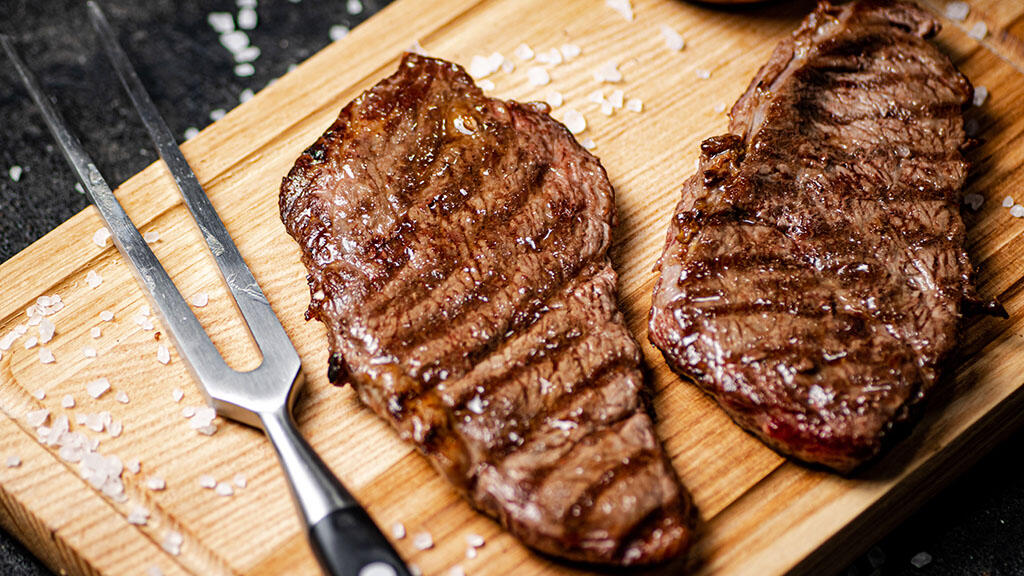
Most cooks have used their fingers to press into the top of a steak to determine if it’s cooked through, used a knife to check the color of the juices flowing from a chicken breast, or simply waited until the timer went off before slicing into a piece of pork. While these methods may seem harmless, they’re actually somewhat unreliable and can lead to unsafe food practices. The most basic tool for improving the reliability of cooking meat is a meat thermometer – costing less than a good bottle of wine, taking up space in any kitchen drawer, and eliminating the biggest variable affecting the cooking of protein-based foods – i.e., the lack of knowledge regarding what is happening inside the meat.
In addition to explaining why using a thermometer is safer than judging the doneness of your meal by feeling the meat, this article provides detailed explanations regarding the correct temperatures for various types of meats, including beef, pork, chicken, turkey, lamb, and fish. Additionally, we explain the importance of “resting” your food after it’s been cooked.
Why judging meat by touch does not work
Home cooks rely on several common ways to determine if meat is cooked through. These methods include pressing your finger into the top of the meat, checking the color of the juices coming out of a chicken breast, and simply waiting until the timer goes off. There is one major flaw in all of these methods: none of them give you a true indication of the internal temperature of the meat. In fact, they provide you with a picture of either the external temperature or how firm/soft the meat feels compared to another area of your body. Pressing your finger into the top of a steak is comparing how firm your thumb feels when you push into it versus pushing into the top of a steak. The problem with this method is that it will vary greatly based upon how thick/thin the steak is, how fatty/muscular it is, how cold/warm the meat started out, and finally how flexible your thumbs are. Two people could perform the exact same finger press test on two pieces of identical meat, yet get completely opposite results.
Timing is also an unreliable method for determining if meat is fully cooked. Any recipe that states to cook something for a certain number of minutes at a given temperature was written specifically for that particular cut of meat in that particular type of oven. If you have a different cut of meat or oven than what was specified in your recipe, your cooking time will be affected by 10 minutes or more. The only information that you receive from measuring the internal temperature of your food is that it is safe to consume and has been cooked to an acceptable temperature. This only comes from measuring the internal temperature at the thickest point of your food and using a thermometer is the only way to obtain this information.
Selecting a good thermometer
All thermometers are not created equal and affect both ease-of-use and accuracy.
Instant-Read Thermometers
An instant-read thermometer is the bare-minimum for any home kitchen. Simply place the probe into the thickest portion of the meat and within 2-5 seconds you will have your answer. Instant-read thermometers such as a Thermapen (and cheaper options available) can accurately read internal temperatures within ± 0.5°C. Because modern instant-read thermometers react quickly enough that you rarely need to hold the oven door open while reading them, they can be used for anything from steaks and roasts to chicken breasts and fish fillets. An instant-read thermometer is probably the most valuable piece of kitchen equipment that most home cooks don’t currently own.
Leave-in probe Thermometers
A leave-in probe thermometer places the probe into the meat and leaves it there throughout cooking. Leave-in probes allow you to continually monitor internal temperature via a cable connected to a display unit located outside the oven. Leave-in probes are perfect for large-roasted items such as whole chickens, legs of lamb and beef rib roasts since you can continually monitor internal temperature without having to open and close the oven door multiple times. Many leave-in probes feature alarms that sound when your desired internal temperature has been achieved. For large-scale roasting applications, leave-in probes remove all ambiguity.
Thermometer types to be avoided
Avoid dial thermometers that feature circular displays with stems extending outward from them. Dial thermometers are slow, inaccurate and hard to read. Also avoid pop-up timers that were included with mass-produced turkeys found in supermarkets. Pop-up timers are set to go off at much too high an internal temperature for ideal cooking and are best considered a backup failure-safety mechanism than as a reliable reference.
Meat Doneness Temperatures – a comprehensive guide
Below are internal temperatures (measured at thickest points – away from bones that transfer heat and artificially inflate internal readings) for each type of protein that indicate when to pull from heat – not final internal temperatures after resting:
Beef & lamb
Of all proteins, beef and lamb are most temperature-sensitive due to consumers eating them at varying levels of doneness, resulting in distinct textures and flavor profiles. Poultry carries virtually no internal risk from bacteria – pathogens reside primarily on surfaces that rapidly achieve high temperatures early in cooking.
- Rare – remove at 49–52°C (120–125°F) bright-red center; extremely soft; peak juiciness.
- Medium-rare – remove at 54–57°C (130–135°F) warm red-to-pink center; tender/juicy – sweet spot for most cuts.
- Medium – remove at 60–63°C (140–145°F) pink center; firmer texture; less juice.
- Medium-well – remove at 65–68°C (150–155°F) slightly pink; noticeably firmer; significantly dryer.
- Well done – remove at > 71°C (>160°F) no pink; firm throughout; significant moisture loss.
For steaks, medium-rare is generally recommended for cuts such as ribeye, sirloin and strip loin by most chefs. Braising cuts such as short ribs or briskets have internal temperatures irrelevant to the actual cooking temperatures (typically 90°C / +195°F) needed to soften tough collagen into gelatin.
Pork
For years food safety guidelines in many countries recommended cooking pork to 77°C (170°F) – a temperature that produced dry leathery meat devoid of pork’s natural sweetness and tenderness. Modern food safety guidelines (revised by USDA in 2011) changed this recommendation to 63°C (145°F) plus a 3 minute resting time — producing pork that is safe; slightly pink in center; and significantly more juicy/flavorful than overcooked versions. Pull pork chops/tenderloins at 60°C (140°F) — this accounts for carry over heat developed during resting. Ground pork needs to reach 71°C (160°F) throughout.
Poultry
Chicken/turkey must reach a safe internal temperature to eliminate Salmonella-type pathogens — no ‘rare’ option exists for poultry. Commonly referenced target internal temperature is 74°C (165°F) for all poultry — instantaneous kill temperature for pathogens. However, food science suggests pathogens are killed at lower temperatures maintained for longer periods. For example, chicken thighs heated to 71°C (160°F) for 1 minute are equally safe as chicken breast pulled @ 74°C (165°F). Achieving this level of precision typically depends upon possession of a reliable thermometer and sufficient confidence in applying this technique by home cooks. Thus, for novice home cooks, 74°C (165°F) in thickest part of thigh (not touching bone) is safest target.
Also note that chicken thighs/legs benefit from cooking slightly past minimum safe internal temperature. Connective tissues in dark meat begin degrading into gelatin near 79–82°C (175–180°F) providing tenderizing effects leading to fall-apart tenderness associated with braising/roasting thighs.
White/dark meat have different ideal temperatures
This is why spatchcocking whole chickens (removing backbone so chicken lies flat) enhances uniformity among white/dark meat portions — providing greater even heating throughout whole chicken.
Fish
Fish represents most delicate protein-based food for temperature control purposes. The margin between perfectly-cooked fish and overcooked fish can be quite small — sometimes only a couple degrees C. Most fish should be cooked to an internal temperature of between 55-60°C (130-140°F) for maximal juiciness/set texture. Salmon is best cooked at lower internal temperatures (50-52°C) for silkier/translucent texture that high-end restaurants strive to achieve although food safety guidelines recommend 63°C (145°F) for vulnerable populations. Raw-in-center tuna steaks are pulled from heat almost immediately after searing exterior — while surface achieves safe temperatures interior remains below 40°C.
Carry-over cooking – the unknown variable
One concept that confounds many home cooks is carry-over cooking — where food continues cooking after removal from heat source. Carry-over occurs because outer layers of food are warmer than inner layer(s) and heat transferred from outer layers to inner layer(s) raises inner temperature 3-8°C depending upon size/density of item.
Example: a thick ribeye steak removed from sizzling-hot cast iron pan at 54°C will rise to 57-60°C during resting. Larger roasts removed from oven at 60°C will increase 5-8°C over 20 minutes resting time. This is why pull temperatures are always lower than final target temperatures — carry-over occurs during resting time.
Using rest time to determine final temperature
Because larger/denser roasts experience greater carry-over effect, consider this factor every time you cook protein-based food and prevent yourself from accidentally overcooking food.
The Resting Rule – why resting is unavoidable
While recipes will frequently mention resting protein-based food after cooking, many home cooks will skip this step when hungry/impatient. Resting is one of the greatest tools available to create high-quality dishes — along with understanding why it works it becomes almost impossible to bypass this step.
What happens when meat rests?
When you apply heat to meat, muscle fibers contract/squeeze moisture toward center of cut. When you slice into meat immediately after cooking those muscle fibers remain contracted/compressed — causing juice to flow out onto cutting board instead of remaining within meat itself. Allowing meat to rest enables muscles fibers to relax/reabsorb some moisture redistributed throughout cut — creating tremendous differences in juiciness between slices taken immediately after cooking vs. slices taken after resting.
How much resting do I need?
Resting time should relate directly to size/density of item cooked. Generally speaking, rest protein-based food for approximately half the total cooking time — maximum 20-30 minutes for largest roasts.
Practical guidelines based on cut size:
- Thin steaks (<2 cm) – rest loosely tented w/foil – 3-5 min
- Thick steaks & chops (2-4 cm) – rest loosely tented w/foil – 5-8 min
- Chicken breasts & thighs – rest loosely tented w/foil – 5 min
- Whole roast chicken – rest loosely tented w/foil – 15-20 min
- Large roasts (leg of lamb/beef rib roast etc.) – rest loosely tented w/foil – 20-30 min
Tenting versus tight wrapping
Always rest protein-based food loosely tented with foil — never tightly wrapped. Tightly wrapping prevents trapped steam from escaping from surface of food which causes crust/sear created prior to resting to become soggy. Loosely tenting retains sufficient heat within food — allowing steam to escape — keeps crust crispy and maintains surface browning.
Combining all elements
Using a reliable instant-read thermometer, establishing accurate internal temperatures for each type of protein-based food and developing discipline when resting food creates one of the only guarantees offered by cooking. Home cooks lose reliance on personal intuition which varies by cook/cut/day. Home cooks cease overcooking chicken based solely on fear and cease undercooking pork based solely on habit. Home cooks start pulling steaks at precisely correct time — allowing adequate resting time to ensure each slice is as juicy as previous ones.