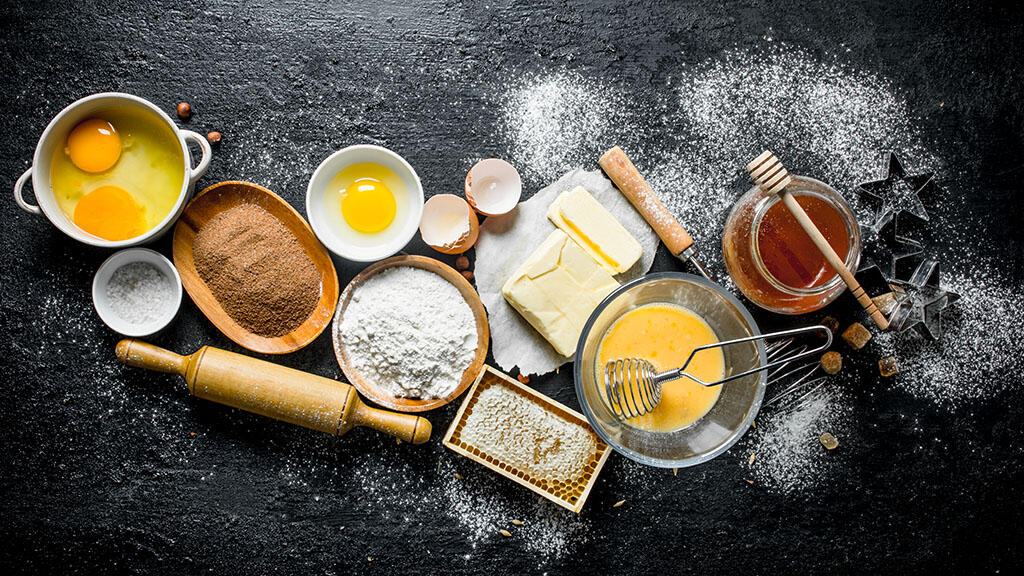
Every experienced home cook knows it: sometimes, you can just wing it with whatever happens to be in the fridge and create a great meal; however, whenever you do that with a cake, the cake always falls, or ends up being too hard, or fails to rise. That is not luck. It is science. Baking and cooking are based upon different scientific principles. Once you understand these differences, you'll not only get better at cooking, but you'll also become a better baker.
Chemistry vs. Technique
Cooking on the stove-top is primarily a mechanical, and sensory process. As you apply heat to foodstuffs, you watch and smell the foods as they cook. As the dishes progress, you continue to taste the food items as they cook. If the food item tastes too acidic, you may need to add a bit of sugar. If the food item is too thick, you can add a bit of liquid. There is a continuous cycle of tasting and adjusting. Because there is such a large degree of flexibility in cooking techniques, you have complete control over the cooking process from beginning to end.
Baking, on the other hand, is primarily a chemical process. When you take a group of ingredients (flour, butter, eggs, etc.) and place them in an oven, you initiate a series of chemical reactions. Protein coagulation, starch gelatinization, carbon dioxide production (leavening), Maillard browning and caramelization occur at nearly the same time. While you have some ability to influence these chemical reactions prior to placing the mixture into the oven, by the time you realize that something has gone wrong with the chemical reactions, it is generally too late to fix the problems.
Measurements Matter in Baking
Unlike cooking, where a recipe calling for "2 cloves of garlic" represents a guideline or preference for the type of garlic used and/or quantity used in preparing the dish; a recipe calling for "200 grams of flour" defines the proportions of its components. For example, when using 220 grams of flour instead of 200 grams of flour in a recipe calling for 200 grams of flour, you have altered the ratio of flour to fat to liquid. This alteration will change the extent of gluten development in addition to changing the moisture level of the finished baked good. Each step in the preparation of a baked good builds upon previous steps; therefore, each alteration made at any stage will have cumulative effects upon the finished product.
Ratio Problems
All baked goods rely upon specific ratios among their various components. For example, a simple butter cake consists of approximately equal portions of butter, sugar, eggs and flour by weight (a 1:1:1:1 ratio). Alterations to either butter, sugar, eggs or flour will alter the overall ratio among these four primary ingredients. Altered ratios will result in varying degrees of gluten development. Excessive amounts of flour compared to fat will yield a very dry and heavy crumb. Conversely excessive amounts of sugar in comparison to flour will produce a cake that bakes quickly due to increased browning (Maillard Reaction) on the outside of the cake before the inside has reached a satisfactory internal temperature. Additionally, excessive amounts of sugar will weaken the gluten structure within the cake; thus causing the cake to collapse upon cooling.
Excessive numbers of eggs relative to all other ingredients will result in a rubbery texture as well as an overly egg-flavored texture. These are not subjective interpretations regarding style; rather these represent predictable results resulting from chemical processes acting upon an unbalanced formula.
Volume vs. Weight
It is for this reason that serious home cooks and professional bakers alike prefer measuring ingredients by weight rather than by volume. Although one cup of flour weighs exactly 100 grams on average, the actual weight of one cup of flour can vary depending upon how it was measured. For example, a cup of flour that was measured using a light scoop would weigh significantly less than a cup of flour that was measured by filling a cup directly from a flour container. Similarly, humidity can greatly affect the density of flour; therefore it is essential that measurement methods remain consistent. Using a digital or analog kitchen scale eliminates virtually all variability inherent in measuring by volume.
Understanding What Each Major Ingredient Performs in Baking
As previously mentioned, each major baking ingredient serves multiple roles; not merely providing flavor. Understanding what each ingredient does helps explain why you cannot replace or remove baking ingredients arbitrarily.
Flour & Gluten
When wheat flour combines with water and undergoes mechanical manipulation (i.e., kneading) two proteins – glutenin and gliadin – combine to form gluten. Gluten is an elastic web of fibers that provides structure and chew to baked products. Kneading more thoroughly will develop greater gluten; producing more chewiness in breads. However, developing too much gluten is disastrous when working with cakes and pastries where excessive gluten produces toughness.
Therefore, cake recipes direct you to “just combine” ingredients; essentially directing you to cease developing gluten before it becomes structurally detrimental. Pastry dough uses cold butter and limited manipulation because cold butter prevents gluten from forming by coating flour particles preventing them from bonding with one another.
Leavening Agents
Baking powder and baking soda are not interchangeable; therefore, using either baking powder or baking soda incorrectly will result in vastly different outcomes. Baking soda is pure sodium bicarbonate that requires an acidic ingredient (e.g., buttermilk, yogurt, vinegar, brown sugar, cocoa powder) to react. Upon combining with an acidic ingredient along with moisture in an oven at elevated temperatures; both sodium bicarbonate and acidic ingredient produce carbon dioxide gases that rapidly expand in oven heat producing the desired rise in baked goods. Therefore without adequate acidity baking soda remains inactive leaving behind unwanted flavors (soapy/metallic) in completed baked goods.
Baking powder includes baking soda along with an inert dry acid (cream of tartar) and starch. The starch acts as filler allowing baking powder to activate with only moisture present thereby eliminating the need for added acidic ingredients in recipes. Many commercial baking powders contain a secondary activating mechanism referred to as double-acting; producing an initial release of carbon dioxide when combined with liquid and a secondary release when exposed to heat produced by the oven. This is why resting batter prior to baking produces similar rising properties regardless of how long batter rests. The delayed action of the second release occurs after oven heating commences.
Using excessive amounts of leavening will result in rapid over-expansion followed by collapse as structural elements fail to harden quickly enough to provide support for expanding bubbles; whereas using insufficient amounts will result in poor rising properties yielding flat and dense baked goods.
Eggs
Eggs serve multiple purposes simultaneously within baking; therefore creating difficulties for those attempting to substitute or eliminate eggs from baked goods.
Proteins contained within egg white coagulate during baking contributing to structural integrity; whereas fats contained within yolk contribute to tenderization, richness and color. Lecithin contained within yolk provides emulsion properties allowing fat and liquids within batter to remain suspended uniformly throughout producing uniform textures; as opposed to isolated regions of fat and liquid.
Whole eggs contribute moisture while beating incorporates air bubbles contributing to leavening properties. Therefore, egg counts specified in recipes define proportional relationships between structural components including moisture content; as well as defining quantities of leavening properties simultaneously.
Fat
Fat within baking serves two seemingly conflicting purposes: it inhibits gluten development (tenderizing) while facilitating incorporation of flavors within baked goods.
Butter is perhaps most commonly utilized fat source within baking; containing approximately 15-18% water per unit mass. This water vapor transforms into steam during baking thereby enhancing leavening properties.
Substituting oil for butter yields differing textures despite utilizing equivalent masses because oil possesses zero water content while possessing more volume-based fat content; therefore producing moist yet denser crumb textures devoid of steam enhancement. Neither option is inherently superior; rather they represent differing approaches toward achieving unique objectives.
Sugar
Sugars' involvement in baking extends far beyond provision of sweetness.
Absorption of water slows down gluten development thereby increasing softness within baked goods. Caramelization on surface creates colors and complex flavors. Retention of moisture post-baking increases storage life of baked goods; which is why low-sugar baked goods exhibit reduced shelf life.
Additionally sugars increase temperature at which proteins contained within eggs coagulate thereby prolonging available time for batters to rise prior to structural completion. Brown sugar contains molasses providing both flavor and increased moisture levels. Granulated sugar dissolves instantaneously providing fine-textured frosting qualities.
Precise Temperature Control in Baking
Precision in baking oven temperature is equally important as ratio specifications due to analogous reasons: chemical reactions occurring within baking involve temperature dependent reactions that proceed sequentially. Oven temperature controls rate at which reactions occur controlling timing at which chemical reactions occur.
At optimal temperature conditions for each particular type of baked good: chemical reactions proceed at rates necessary for maximum utilization. Chemical reactions occur rapidly enough for structural components to achieve maximum strength prior to exterior surfaces becoming sufficiently hardened via Maillard reaction/caramelization for structural stability.
If oven temperature exceeds optimal temperatures for given baked good: exterior surfaces become sufficiently hardened prior to interior reaching optimal internal temperature; therefore exhibiting characteristic dome-shaped cracks on exterior surfaces accompanied by excessively gummy interiors.
Conversely, if oven temperatures fall below optimal temperatures for given baked good: melted fat flows prematurely leading to flat appearance and greasiness on surface.
Calibration of Ovens
Many home ovens deviate significantly from indicated dial settings; often by as much as ± 10-20C°. Digital or analog oven thermometers are inexpensive ($5-$10); however provide significant improvements when calibrating ovens.
Place thermometer in center of oven cavity; then record indicated temperature reading against oven dial reading. If indicated temperature reading differs by 20C° from oven dial reading; then record oven dial readings corresponding to correct calibrated temperature range for future reference purposes.
Preheating the Oven
Prior to loading baked goods into an oven whose ambient temperature has not achieved optimal baking conditions results in excess exposure time at lower temperatures prior to onset of real baking activity. During this interval: leavening agents may become exhausted releasing all possible CO² prior to attaining adequate thermal energy for structural matrix development surrounding bubbles; hence producing flat finished baked goods.
Always preheat ovens for at least 20 min prior to loading baked goods; verifying with thermometer before placing baked goods into oven cavity.
Creative Freedom Exists in Baking
While precision within baking applies primarily to fundamental structures defined by ratios among major ingredients (flour-fat-liquid-eggs-leavening): ample room for creative expression exists within established structures.
For example flavor additions (vanilla-citrus-zest-spices-extracts) may be substituted/added without compromising structural integrity since these do not affect structural characteristics of baked goods. Mixing-in's (chocolate chips-nuts-dried fruits-seeds) generally possess negligible structural impacts unless used in extreme quantities. Frostings/fillings/glazes/toppings typically allow for complete creative freedom.
Once you comprehend role played by each key component within your baked goods: you can begin making informed substitutions (brown butter-for-white butter-espresso powder-to enhance chocolate flavors-almond flour-to reduce gluten/retain moisture): with full awareness of potential consequences.